Humanoids at work Guide
Humanoid robots in factories: what they really do in 2026
Which humanoid robots really work in factories and warehouses, what they lift, what they cost to buy or rent, and when a pilot makes sense for your site.
On this page 10
- Are humanoid robots actually working in factories in 2026?
- Where humanoid robots really work in 2026
- Pilot, paid pilot or production: how to read a deployment claim
- Which companies use humanoid robots in factories and warehouses?
- What tasks humanoid robots do on the floor
- Payload, runtime and safety: the limits that decide a pilot
- How much do industrial humanoid robots cost?
- Is a humanoid pilot right for your site?
- Frequently asked questions
- Bottom line
Yes, humanoid robots in factories and warehouses do real work in 2026, but most remain in supervised pilots, not full production. The International Federation of Robotics reports about 7,000 full-size humanoids sold worldwide in 2025. This guide covers humanoids working inside factories, not the factories that build them.
Separating a launch video from a multi-shift contract requires looking at payload limits, battery swap times, and verified customer statements. In our deployments tracker, we log announced orders, testbed trials, and commercial rollouts so operations managers can verify which machines actually move freight and parts on the floor today.
Are humanoid robots actually working in factories in 2026?
Yes, a small number of humanoid robots work in commercial factories and warehouses in 2026. Most operate in paid pilots rather than full-scale production, handling repetitive tasks like moving plastic totes, sequencing automotive parts, and loading tablets into test equipment under human supervision.
Where humanoid robots really work in 2026
Industrial humanoid robots operate in two primary environments in 2026: third-party logistics (3PL) fulfillment centers and automotive or electronics assembly plants. According to the International Federation of Robotics, about 7,000 full-size humanoids (taller than 140 cm (4 ft 7 in)) were sold worldwide in 2025, yet the organization notes that most applications remain specialized, often require human teleoperation, and face hurdles such as safety standards, training and maintenance cost, and a weak industrial business case (Source: IFR).
Logistics warehouses represent the earliest commercial adoptions because moving standard plastic totes between conveyors and autonomous mobile robots (AMRs) happens in structured aisles. In manufacturing, automotive OEMs and electronics contract manufacturers test industrial humanoid robots for lineside parts delivery and machine tending. These sites already run automation cells, meaning their engineering teams understand how to fence off work zones and integrate robot fleet managers with warehouse management systems (WMS).
Not every low-cost machine on the market belongs on a plant floor. For example, Unitree lists the Unitree H2 at $29,900 (official price, excluding tax and shipping), with maker specs of about 7 kg (15 lb) rated and 15 kg (33 lb) peak payload per arm, about 3 hours of runtime, and a weight of about 70 kg (154 lb). However, Unitree explicitly calls the H2 a civilian robot and instructs users to keep a wide distance from people, so we do not treat it as an industrial production robot.
Pilot, paid pilot or production: how to read a deployment claim
When a robot maker announces a factory deal, the press release rarely explains whether the customer bought a fleet or simply let the vendor film a two-hour test in a corner of the warehouse. To evaluate how top industrial humanoids perform, we classify every site record in our database using five strict deployment stages:
- Demo: A short, choreographed task filmed at a customer site or trade show, often relying on teleoperation or pre-scripted routines with no integration into plant software.
- Pilot: A time-limited trial at a named customer facility where engineers validate safety, cycle time, and reliability, with no public commercial orders.
- Paid pilot: A structured trial where the customer pays for the validation phase or signs a conditional agreement with performance milestones before committing to a multi-year rollout.
- Production: Robots run regular shifts alongside human staff or inside production cells, integrated with the site’s WMS or manufacturing execution system (MES) under a commercial contract.
- Announced: A signed partnership, memorandum of understanding, or multi-year order target where robots have not yet started working on the factory floor.
Understanding these distinctions protects buyers from overestimating readiness. In our database, robot availability statuses also follow fixed definitions: a robot marked as pilot works shifts at named customers without public order books, while shipping means anyone can place an order and receive hardware. When reading the table below, check both the stage column and the label indicating whether a figure is a maker claim, a customer statement, or a reported number from financial filings.
Which companies use humanoid robots in factories and warehouses?
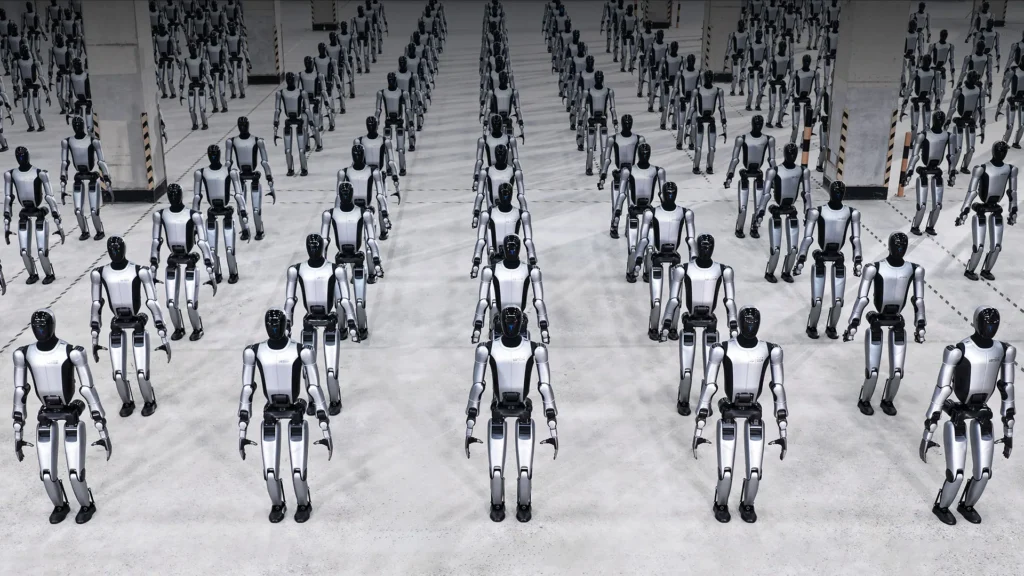
Logistics provider GXO, automakers Hyundai, BYD, Geely, and FAW-Volkswagen, aircraft manufacturer Airbus, and electronics maker Longcheer are among the companies testing or running humanoid robots in factories and warehouses. The table below summarizes the reported deployments for the five factory-focused models tracked in our database as of November 2026.
| Robot | Customer or site | Task | Stage | Payload (kg) | Runtime (h) | Source date |
|---|---|---|---|---|---|---|
| Agility Robotics Digit 4 | GXO (Flowery Branch, GA; expanding to NC and TN in early 2027); reported at Schaeffler, Toyota Motor Manufacturing Canada, Mercado Libre (9 facilities total) | Moving totes from cobots onto conveyors | Production (GXO RaaS agreement; expansion announced) | Not disclosed | Up to 4 (maker claim) | 2024-06-27 / 2026-06-24 / 2026-10-26 |
| Boston Dynamics Atlas | Hyundai Robotics Metaplant Application Center (RMAC) near Savannah, GA; Google DeepMind | Training on logistics and auto-parts sequencing (production targeted for 2028) | Pilot (testbed training; 2026 units fully committed) | 30 kg (66 lb) sustained / 50 kg (110 lb) instant (maker claims) | 4 with autonomous battery swap (maker claim) | 2026-01-05 / 2026-09-21 |
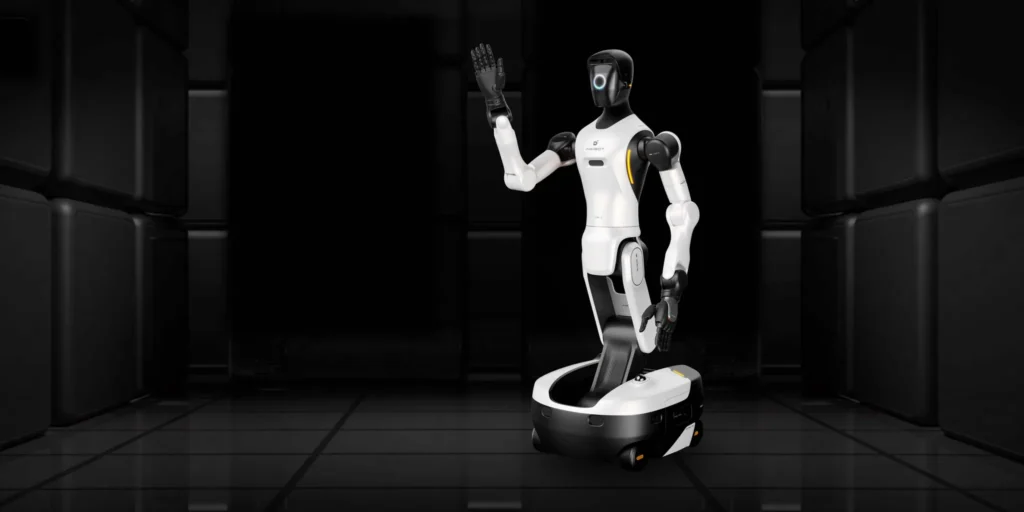
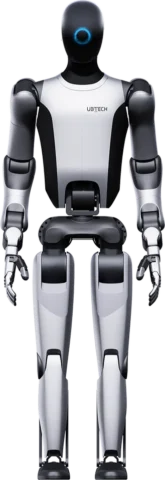
| UBTech Walker S2 | BYD, Geely, FAW-Volkswagen, Dongfeng Liuzhou, Foxconn, SF Express (maker claims); Airbus (reported) | Early concept testing in aviation manufacturing (Airbus); automotive and logistics tasks | Pilot (Airbus reported) / Production deliveries claimed by maker | 15 kg (33 lb) (maker claim) | Not disclosed (autonomous battery swap under 3 min for 24/7 operation, maker claim) | 2025-11-17 / 2026-01-22 |
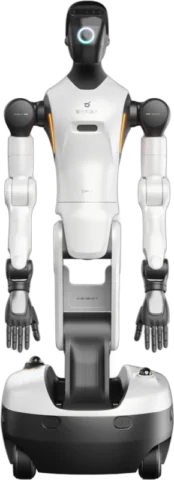
| AgiBot G2 | Longcheer (Nanchang plant) | Picking tablets off conveyors, loading test equipment, sorting pass/fail units | Production (main line from March 2026, reported) | 5 kg (11 lb) per arm / 10 kg (22 lb) both arms / 15 kg (33 lb) peak (maker claims) | About 4 on two hot-swappable batteries (maker claim) | 2026-06-29 |
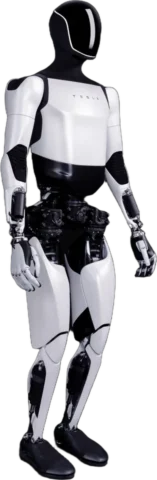
| Tesla Optimus Gen 2 | No disclosed Gen 2 deployment (Tesla claims next-generation Optimus production started at Fremont, CA) | Not disclosed | Prototype (database status for Gen 2; production claimed by Tesla for next-generation Optimus) | Not disclosed | Not disclosed | 2026-10-21 |
In June 2024, GXO signed a multi-year Robots-as-a-Service (RaaS) agreement for Agility Robotics Digit and the Agility Arc software after a late-2023 proof-of-concept pilot, with both companies calling it the first formal commercial humanoid deployment (company claim). According to an October 2026 update, Digit has moved more than 100,000 totes at GXO Flowery Branch, Georgia (Agility claim) (Source: Agility Robotics). GXO will add Digit at Statesville, North Carolina, and Lebanon, Tennessee, from early 2027, starting on Digit 4, though expansion terms were not disclosed. Agility claims Digit has logged more than 65,000 operating hours over nearly three years of commercial deployment, and The Robot Report reported in June 2026 that Digit is in commercial use at Schaeffler, Toyota Motor Manufacturing Canada, and Mercado Libre across 9 customer facilities.
In the automotive sector, Boston Dynamics opened the Robotics Metaplant Application Center (RMAC) at Hyundai Metaplant America near Savannah, Georgia, in September 2026. RMAC serves as a testbed and training center where Atlas, still in development, trains on logistics and auto-parts sequencing as a pilot rather than production. Hyundai Motor Group plans to use Atlas for parts sequencing at the Metaplant from 2028 and for component assembly by 2030, after process-by-process validation of safety and quality. Meanwhile, in China, UBTech claimed in November 2025 that mass production and delivery of Walker S2 began, citing Walker-series orders since early 2025 above 800 million yuan (about $112 million) from named customers including BYD, Geely, FAW-Volkswagen, Dongfeng Liuzhou, Foxconn, and SF Express. UBTech’s HKEX interim results reported 921 full-size humanoid robots sold across all its full-size models in the first half of 2026, with RMB 590.3 million in revenue from them. Reuters reported in January 2026 that Airbus bought an undisclosed number of Walker S2 units for early concept testing.
Two additional factory deals involve companies whose robots are not yet in our database. Figure AI claims its robots worked an 11-month deployment at BMW Spartanburg loading sheet metal into weld fixtures, logging more than 90,000 parts loaded and more than 1,250 hours of runtime in a November 2025 post that included no BMW statement. In May 2026, UK company Humanoid announced a binding phased RaaS deal with Schaeffler, claiming phase 1 runs from December 2026 to June 2027 at Herzogenaurach and Schweinfurt in Germany, with a target of a four-digit number of robots by 2032.
What tasks humanoid robots do on the floor
A humanoid robot warehouse or manufacturing deployment in 2026 focuses on four narrow, repetitive jobs where existing conveyor or AMR systems leave a manual gap:
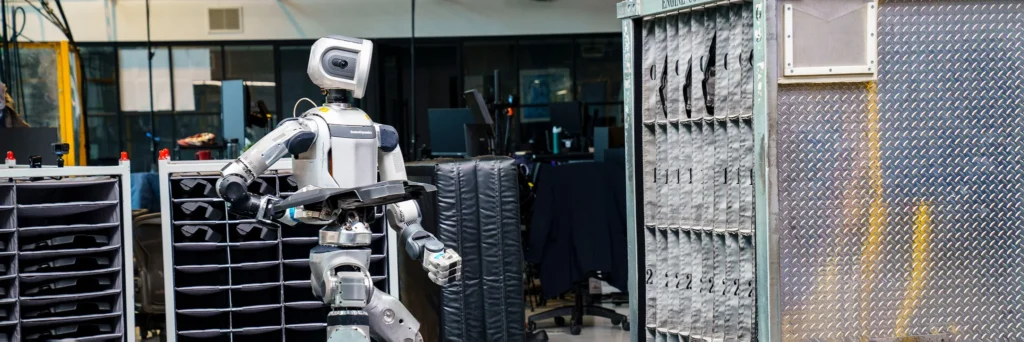
- Tote handling and conveyor transfers: At GXO’s SPANX facility, Digit moves plastic totes from cobots onto conveyors, bridging the gap between mobile robots and fixed conveyor lines.
- Parts sequencing and kitting: At Hyundai’s RMAC testbed, Atlas trains to pick automotive components from storage racks and arrange them in the exact order needed for the assembly line.
- Machine loading and sheet-metal tending: Placing stamped metal parts into welding fixtures (as claimed by Figure AI at BMW) requires reaching into machinery built for human stature and clearing the zone before the press or welder cycles.
- Quality inspection and test loading: Yicai Global reported in June 2026 that AgiBot G2 robots at Longcheer’s Nanchang plant pick tablets off conveyors, load them into test equipment, and sort pass and fail units.
Moving from a test line to main production requires extensive debugging. At Longcheer, Yicai reported that the AgiBot G2 units started on a secondary line in December 2025 and moved to the main line in March 2026 only after engineers fixed about 60 issues, including sensor misreads that caused collisions. If you are evaluating different form factors for these jobs, you can inspect physical dimensions and joint counts in our Boston Dynamics Atlas vs Tesla Optimus Gen 2 comparison, though note that Tesla stated in October 2026 that it started production of its next-generation Optimus at its Fremont factory without publishing payload or runtime specs.
Payload, runtime and safety: the limits that decide a pilot
Physical specifications determine whether a humanoid can survive an eight-hour factory shift. When reading datasheets for humanoid robots in manufacturing, operations engineers must separate peak marketing numbers from continuous working capacity across four technical constraints.
Sustained vs. instant payload: Makers often advertise an instant (peak) payload, the most a robot can lift briefly. What matters for a shift is the sustained payload at reach. For example, Boston Dynamics lists a 30 kg (66 lb) sustained payload and a 4-hour battery with autonomous swap for Atlas, alongside a 50 kg (110 lb) instant payload (maker claims). Atlas stands 1.9 m (6 ft 3 in) tall, weighs 90 kg (198 lb), features 56 degrees of freedom (DoF, the number of joints the robot can move), and carries an IP67 rating for dust and water protection across a -20 to 40 C (-4 to 104 F) operating range. By contrast, AgiBot’s user manual for the G2 lists a rated payload of 5 kg (11 lb) per arm, 10 kg (22 lb) with both arms, and a 15 kg (33 lb) dual-arm peak. Agility says its upcoming Digit 5 (announced in September 2026, not yet in our database) lifts 22.7 kg (50 lb), which is 40% more than Digit 4.
Runtime, docking, and battery swaps: The humanoids in this guide that publish runtime list about three to four hours per charge (maker claims). Agility claims the Digit battery lasts up to four hours (though Agility’s own runtime figures differ between releases) and operates in temperatures from 0 to 35 C (32 to 95 F). If a robot plugs into a wall charger for two hours after every four-hour shift, a plant needs two robots to cover one continuous station. To avoid this downtime, UBTech claims the Walker S2 (rated for a 15 kg (33 lb) payload) completes an autonomous battery swap in under 3 minutes to support 24/7 operation, while the AgiBot G2 runs for about 4 hours on two hot-swappable batteries.
Wheeled vs. legged bases: Legged robots like Digit, Atlas, and Walker S2 can step over floor cabling and turn in tight spaces, but every step consumes battery power and introduces balance risks. When a factory has flat, smooth concrete aisles, a wheeled base often makes more sense. The AgiBot G2 mounts its torso and arms on a wheeled base, bringing its total weight to 185 kg (408 lb) while eliminating the energy cost and fall risk of bipedal walking.
Safety standards and regulatory gaps: As of late 2026, no published international safety standard specifically governs legged humanoid robots. ISO 10218-2:2025 covers the integration of industrial robot applications and cells (complementing ISO/TS 15066 for collaborative applications), but it explicitly excludes robots integrated on mobile platforms. The dedicated standard, ISO 25785-1—which sets safety requirements for dynamically stable industrial mobile robots, defined as legged and wheeled robots that need active balance in workplaces where the public is excluded or restricted—was still a committee draft (stage 30.60) on July 8, 2026. In Europe, the EU Machinery Regulation (EU) 2023/1230 applies from January 20, 2027 and covers AI-based safety functions, while machinery placed on the market before then follows Directive 2006/42/EC. Until ISO 25785-1 is finalized, makers rely on internal functional safety architectures; Agility notes that safety standards for dynamically stable mobile robots are still in development and equips Digit with a category 1 controlled stop, a safety PLC rated PLd, an on-robot E-stop, and a wireless E-stop.
How much do industrial humanoid robots cost?
Robots-as-a-Service (RaaS) is a subscription pricing model where a factory pays a recurring fee to use a humanoid robot rather than buying the hardware outright. Agility, for example, says its RaaS fee covers maintenance, updates, and support.
Agility Robotics
Agility Robotics Digit 4
- Height
- 175 cm
- Weight
- 63.5 kg
- DoF
- 28
- Runtime
- 4 h
UBTech Robotics
UBTech Walker S2
- Height
- 176 cm
- Weight
- 70 kg
- DoF
- 52
- Runtime
- 2.5 h
AgiBot
AgiBot G2
- Height
- 180 cm
- Weight
- 185 kg
- DoF
- 25
- Runtime
- 4 h
Official price tags for factory humanoids are rarely published on vendor websites; in our database, Atlas and Optimus Gen 2 are listed as price TBA, while Digit 4, Walker S2, and AgiBot G2 are quoted on request. Agility states in its FAQ that it offers Digit either as a capital purchase (plus a maintenance fee) or as RaaS, noting only that the total cost is comparable to a high-capacity AMR fleet.
However, financial filings provide a concrete benchmark for humanoid robot pricing. In September 2026, The Robot Report, citing Agility’s SEC S-4 filing, reported RaaS pricing for the next-generation Digit of about $8,500 per robot per month plus a $25,000 deployment fee (Source: The Robot Report). The same filing reported an outright purchase price of about $200,000 per robot, plus a $20,000 deployment fee and about $36,000 a year for software and maintenance. By our calculation from those reported figures ($8,500 x 12 + $25,000, or $200,000 + $20,000 + $36,000), a single next-generation Digit would cost roughly $127,000 in its first year on a RaaS contract, or $256,000 in year-one capital and software expenses if purchased outright. Agility also reported more than $300 million in multi-year orders subject to contractual milestones.
Is a humanoid pilot right for your site?
Before signing a pilot agreement, plant managers should compare a humanoid against traditional automation. If your facility has wide, flat aisles and standardized pallets, a conventional AMR combined with a fixed collaborative robot (cobot) arm is often the simpler option, and fixed robot cells already fall under ISO 10218-2:2025, which excludes robots integrated on mobile platforms. A humanoid robot factory trial only makes sense when your floor layout is built strictly for human geometry—such as narrow catwalks, tight lineside racks, or stations that must be shared with manual shifts without bolting tracks to the concrete.
If your engineering team is preparing to speak with vendors, use this seven-point checklist to structure the technical review:
- Task definition and cycle time: What is the exact pick-and-place rate per hour, and how does that compare to a human operator or a fixed cobot?
- Sustained payload at reach: Does the robot’s continuous two-arm payload rating cover your heaviest tote or metal stamping when its arms are extended away from its torso?
- Runtime and charging ratio: Does the robot swap its own battery in under 3 minutes, as UBTech claims for the Walker S2, or will you need two robots per station to cover charging downtime?
- Floor conditions and safety zones: Since ISO 25785-1 is still a committee draft, how will you fence or LiDAR-zone the work cell to keep human staff safe if the robot loses balance?
- Teleoperation disclosure: What percentage of the pilot task runs fully autonomously, and how often must a remote human operator step in to recover from sensor errors or dropped parts? (See our guide on teleoperation vs autonomy for details on how vendors supervise fleets.)
- WMS and MES integration: Does the vendor’s fleet software (such as Agility Arc) connect directly to your existing warehouse or manufacturing execution software, or does it require custom middleware?
- Price model and milestone exits: Are you signing a RaaS subscription or a capital purchase, what is the upfront deployment fee, and what uptime milestones must the robot pass before the multi-year contract locks in?
Frequently asked questions
Can humanoid robots replace warehouse workers?
Humanoid robots in warehouses do not replace full warehouse staff in 2026; instead, they handle isolated, repetitive tasks like transferring plastic totes from mobile robots onto conveyors. The International Federation of Robotics notes that most humanoid applications remain specialized, often require human teleoperation, and face hurdles including safety standards, training and maintenance costs, and a weak industrial business case.
Are factory humanoid robots teleoperated?
Many factory humanoid robots still rely on human teleoperation for at least part of their work. According to the International Federation of Robotics, most humanoid applications are specialized and often require human teleoperation, so buyers should ask each vendor what share of a pilot task runs autonomously and how often a remote operator steps in.
Is there a safety standard for humanoid robots?
There is no finalized international safety standard specifically for humanoid robots as of late 2026. ISO 10218-2:2025 covers industrial robot cells but excludes mobile platforms, while ISO 25785-1—which covers dynamically stable legged and wheeled industrial mobile robots that need active balance—remained in committee draft stage (30.60) in July 2026.
Can you buy an industrial humanoid robot today?
Yes, industrial buyers can order certain humanoid robots today, though availability depends on the maker. In the HumanRobots.si database as of November 2026, the UBTech Walker S2 and AgiBot G2 have a shipping status with pricing on request, while the Agility Robotics Digit 4 and Boston Dynamics Atlas remain in pilot status, meaning they work at named customers without a public order book, with 2026 Atlas units fully committed.
How long can a humanoid robot work on one charge?
Industrial humanoid robots that publish runtime figures list about three to four hours on a single battery charge (maker claims). Agility Robotics claims the Digit battery lasts up to four hours, Boston Dynamics claims a four-hour battery for Atlas with autonomous battery swapping, and AgiBot lists about four hours of runtime for the wheeled G2 using two hot-swappable batteries.
Bottom line
Evaluating humanoid robots in factories requires looking past choreographed videos and focusing on sustained payload, battery turnaround, and verified contract stages. Here is how to proceed based on your role:
- Operations and logistics managers: If you move standard totes in high volume and want a commercial contract, look at RaaS offers with a claimed operating record, such as the Agility Robotics Digit 4 (Agility claims more than 65,000 operating hours across Digit deployments), or consider a wheeled base like the AgiBot G2 if your floors are flat and you want to avoid legged balance risks. Always calculate whether a standard AMR and cobot cell can do the job for less money before paying a deployment fee (The Robot Report reported $25,000 for next-generation Digit RaaS).
- Manufacturing and automation engineers: Treat 2026 and 2027 as validation years. Follow the example of Hyundai’s RMAC testbed or Longcheer’s secondary line by isolating the robot in a dedicated test cell until you resolve sensor collisions and verify safety PLC stopping distances ahead of the ISO 25785-1 standard.
- Analysts, journalists, and investors: Track revenue and shipped unit filings—such as UBTech’s 921 full-size units sold in the first half of 2026 or Agility’s 9 reported customer sites—rather than multi-year order targets that depend on future contractual milestones.
Ready to check specifications across every model in our database? Compare the robots side by side with our humanoid robot comparison tool.
Robots in this guide
Live prices and status from our database.
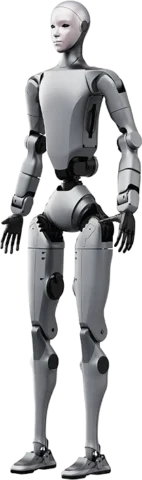 Unitree H2Unitree Robotics · China$29,900OfficialAgility Robotics Digit 4Agility Robotics · United StatesOn requestQuote only
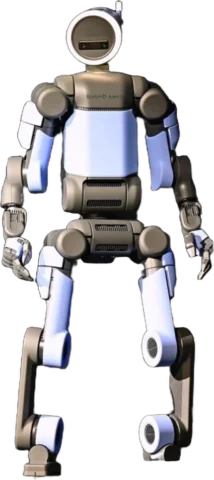 Boston Dynamics AtlasBoston Dynamics · United StatesTBANot announced
 UBTech Walker S2UBTech Robotics · ChinaOn requestQuote only
 AgiBot G2AgiBot · ChinaOn requestQuote only
 Tesla Optimus Gen 2Tesla · United StatesTBANot announced
Sources
- Agility Robotics: GXO signs multi-year agreement (2024-06-27) agilityrobotics.com
- Agility Robotics: GXO and Agility expand partnership (2026-10-26) agilityrobotics.com
- Agility Robotics: Digit 5 announcement (2026-09-15) agilityrobotics.com
- Agility Robotics: FAQ agilityrobotics.com
- The Robot Report: Agility Robotics reports revenue ahead of SPAC (2026-09-07) therobotreport.com
- Boston Dynamics: Atlas product page bostondynamics.com
- Boston Dynamics: RMAC opening (2026-09-21) bostondynamics.com
- Hyundai Motor Group: AI robotics strategy at CES 2026 hyundaimotorgroup.com
- UBTech: Walker S2 mass production and orders (2025-11-17) roboticstomorrow.com
- UBTech: 2026 interim results (HKEX) www1.hkexnews.hk
- Yicai Global: AgiBot G2 tablet inspection at Longcheer (2026-06-29) yicaiglobal.com
- TechCrunch: Tesla starts Optimus production in California (2026-10-21) techcrunch.com
- ISO 10218-2:2025 committee.iso.org
- ISO 25785-1 project status (ISS mirror) iss.rs
- European Commission: Machinery Regulation (EU) 2023/1230 single-market-economy.ec.europa.eu